


Why Do Some Flashlights Stay Bright While Others Gradually Dim?
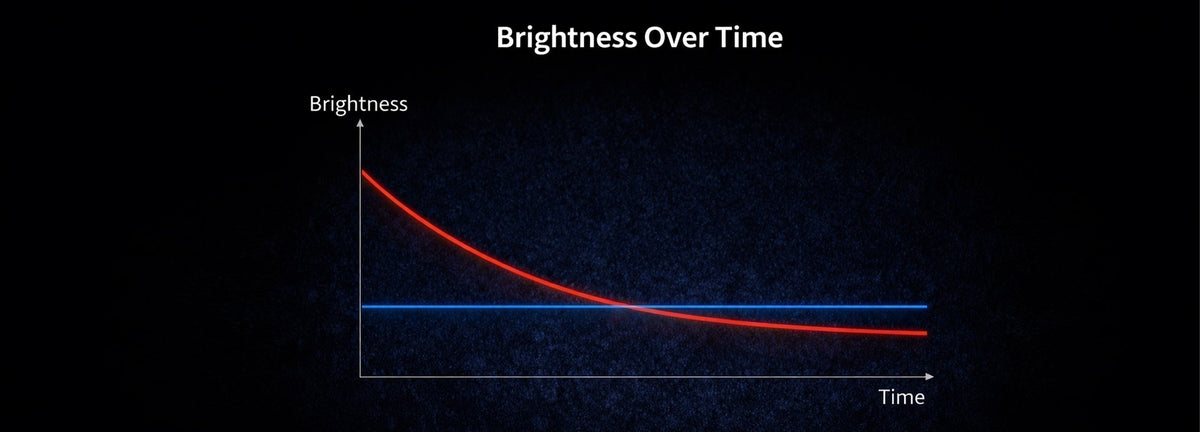
A flashlight may start bright and gradually become dimmer as the battery drains.
Another flashlight may hold a more consistent output for much of its runtime.
One major reason is the driver circuit—the electronics that control how power moves from the battery to the LED.
More Than Peak Brightness
The FIELDLUME TAC20 Tactical Flashlight offers multiple output levels for different lighting needs, making it a useful example of why flashlight performance is about more than the highest lumen number.

What Is a Flashlight Driver?
The driver is the electronic circuit between the battery and the LED.
Its job can include:
- controlling LED current;
- creating different brightness modes;
- responding to battery voltage;
- managing Turbo or step-down behavior;
- protecting parts of the electrical system.
In simple terms, the driver helps determine how the flashlight delivers power, not just how much power the battery contains.

Why Can Brightness Drop as the Battery Drains?
Rechargeable batteries do not maintain exactly the same voltage throughout their discharge cycle.
If LED current changes as battery voltage falls, light output can change as well.
A regulated driver can control the current supplied to the LED instead of allowing output to follow battery voltage directly.
Constant-current LED driving is widely used because controlling LED current helps produce more predictable light output.

Does Regulated Output Mean Perfectly Flat Brightness?
Not necessarily.
A flashlight can still reduce output because of:
Thermal regulation — high output may create enough heat to trigger step-down.
Low battery voltage — the driver eventually reaches the limits of what the battery can provide.
Mode programming — some output changes are intentional.
Driver design — different circuits regulate power in different ways.
So a regulated flashlight does not have to remain at exactly the same brightness until the battery is empty.
Driver Regulation vs Thermal Step-Down
These are related but different ideas.
Driver regulation controls how electrical power is delivered to the LED.
Thermal step-down reduces output when high-power operation needs to be managed.
A flashlight can use both.
Related Guide: Why Do High-Lumen Flashlights Step Down? →
Why Does This Matter When Choosing a Flashlight?
Peak lumens tell you how bright a flashlight can become.
They do not tell you exactly how output behaves throughout the battery cycle.
For a more complete picture, consider:
- output modes;
- runtime;
- thermal step-down;
- battery capacity;
- regulated output behavior.
That is more useful than judging a flashlight by one maximum lumen figure.

Key Takeaway
The driver circuit controls how power moves from the battery to the LED.
Good output regulation can help keep LED current more predictable as battery conditions change, but real flashlight brightness still depends on the entire system.
Think of it as:
Battery + Driver + LED + Thermal Management
—not just the LED alone.
Look Beyond Peak Lumens
The FIELDLUME TAC20 Tactical Flashlight combines multiple brightness levels with a high-output design for different outdoor and tactical lighting needs.

FAQ
What does a flashlight driver do?
It controls how electrical power from the battery is supplied to the LED and can also manage modes and other operating functions.
Why does my flashlight get dimmer as the battery drains?
Battery voltage changes during discharge. The flashlight's driver design affects how much those changes influence LED output.
Does a regulated flashlight stay equally bright until the battery is empty?
Not always. Thermal regulation, low battery voltage and programmed output changes can still reduce brightness.
Share:
How Do Flashlight LEDs Work?
Why Do High-Lumen Flashlights Step Down?