


Red vs Green Light: Which Beam Color Is Better for Night Use?
Red and green flashlight beams are commonly used for low-light outdoor tasks, but they are useful for different reasons.
Red light can be helpful when preserving dark adaptation matters.
Green light can provide stronger visual contrast and make terrain or objects easier for the human eye to distinguish.
Neither color is automatically better.
The right choice depends on what you need to see and how much light you want to introduce into the environment.

Green Light for Clearer Field Visibility
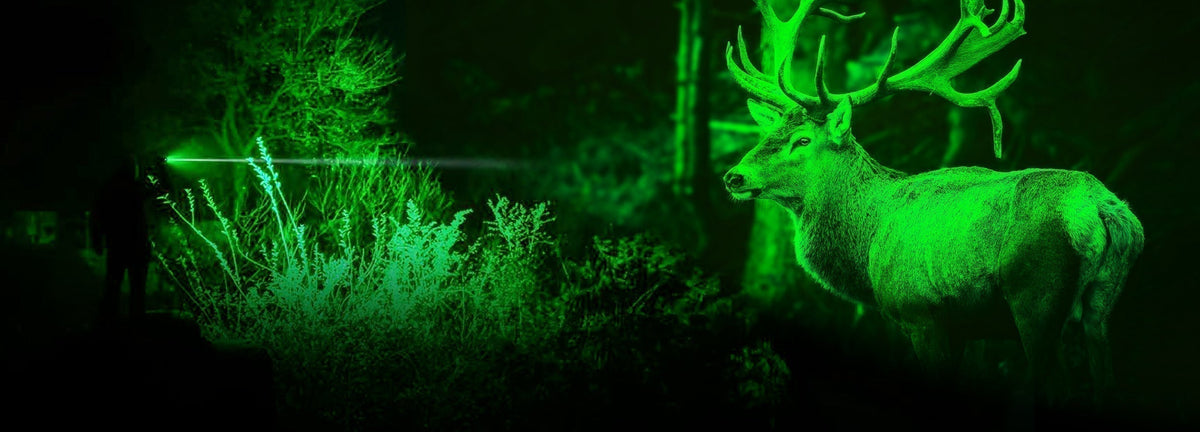
The FIELDLUME HG1 Green Hunting Light produces a dedicated green beam designed for longer-range outdoor and hunting use.

Why Use Red Light at Night?
Human night vision relies heavily on rod cells.
These cells become increasingly sensitive as your eyes adapt to darkness, but they are relatively less sensitive to longer red wavelengths than to shorter wavelengths.
This is why dim red lighting is commonly used when people want some illumination without immediately exposing their eyes to bright white light.
Red can be useful for:
- checking equipment;
- reading controls;
- navigating around a campsite;
- maintaining low ambient light;
- short low-light tasks.
However, red light also makes some colors harder to distinguish.
The FAA, for example, notes that red cockpit lighting can help with dark adaptation but can significantly distort colors.
So red is useful—but not for every visual task.

Why Use Green Light?
Human vision is highly sensitive to wavelengths around the green portion of the visible spectrum.
Rod-mediated night vision reaches peak sensitivity around the blue-green region, roughly 500 nm.
In practical terms, green light can make shapes, terrain and contrast easier to perceive than deep red light at similar low-light levels.
That can make green useful for:
- scanning outdoor terrain;
- identifying shapes at distance;
- navigation;
- hunting and field observation;
- situations where more visual detail is useful.
The trade-off is that green light generally stimulates night vision more strongly than deep red light.

Red vs Green: Quick Comparison
| Red Light | Green Light | |
|---|---|---|
| Dark adaptation | Better suited to preserving it | More disruptive |
| Visual detail | Lower | Higher |
| Color recognition | Limited | Better than red |
| Typical role | Close low-light tasks | Visibility and scanning |
| Outdoor use | Navigation / equipment | Terrain / longer-range observation |
This is a general guide, not a rule for every flashlight or every environment.
What About Hunting?
It is too simplistic to say that animals cannot see red light.
Different species have different visual systems and sensitivities. Their responses to artificial light can also depend on brightness, movement, distance, previous exposure and surrounding conditions.
For this reason, no visible beam color should be treated as universally invisible to wildlife.
Red — lower-impact illumination when preserving human dark adaptation is important.
Green — stronger visual clarity when scanning terrain or observing at greater distance.
White light still remains useful when accurate color identification is the priority.

A Real-World Example: FIELDLUME HG1
The FIELDLUME HG1 Green Hunting Light uses a dedicated green LED with up to 800 lumens for outdoor and hunting illumination.
Rather than thinking of green as a “stealth” color, its practical advantage is easier to explain:
A green beam can provide useful visual contrast for scanning and identifying terrain in low-light environments.
Key Takeaway
Red and green light solve different problems.
Red = better for preserving dark adaptation
Green = better for visual sensitivity and detail
White = better when natural color recognition matters
There is no universal winner.
Choose the beam according to the task.
See a Purpose-Built Red Hunting Beam
The FIELDLUME HR1 Red Hunting Light delivers a dedicated red beam for longer-range field observation and night hunting.

FAQ
Does red light preserve night vision?
Dim red light can help preserve dark adaptation better than brighter shorter-wavelength light, although brightness level still matters.
Is green light easier to see at night?
The human visual system is highly sensitive around the green and blue-green region under low-light conditions, which can make green illumination effective for seeing detail.
Can animals see red or green light?
It depends on the species and conditions. Avoid treating any visible beam color as universally invisible to wildlife.
Is red or green better for hunting?
Neither is universally better. Red may suit lower-light tasks, while green can provide better visual clarity for scanning and observation.
Share:
Why Does Your Flashlight Get Hot?