


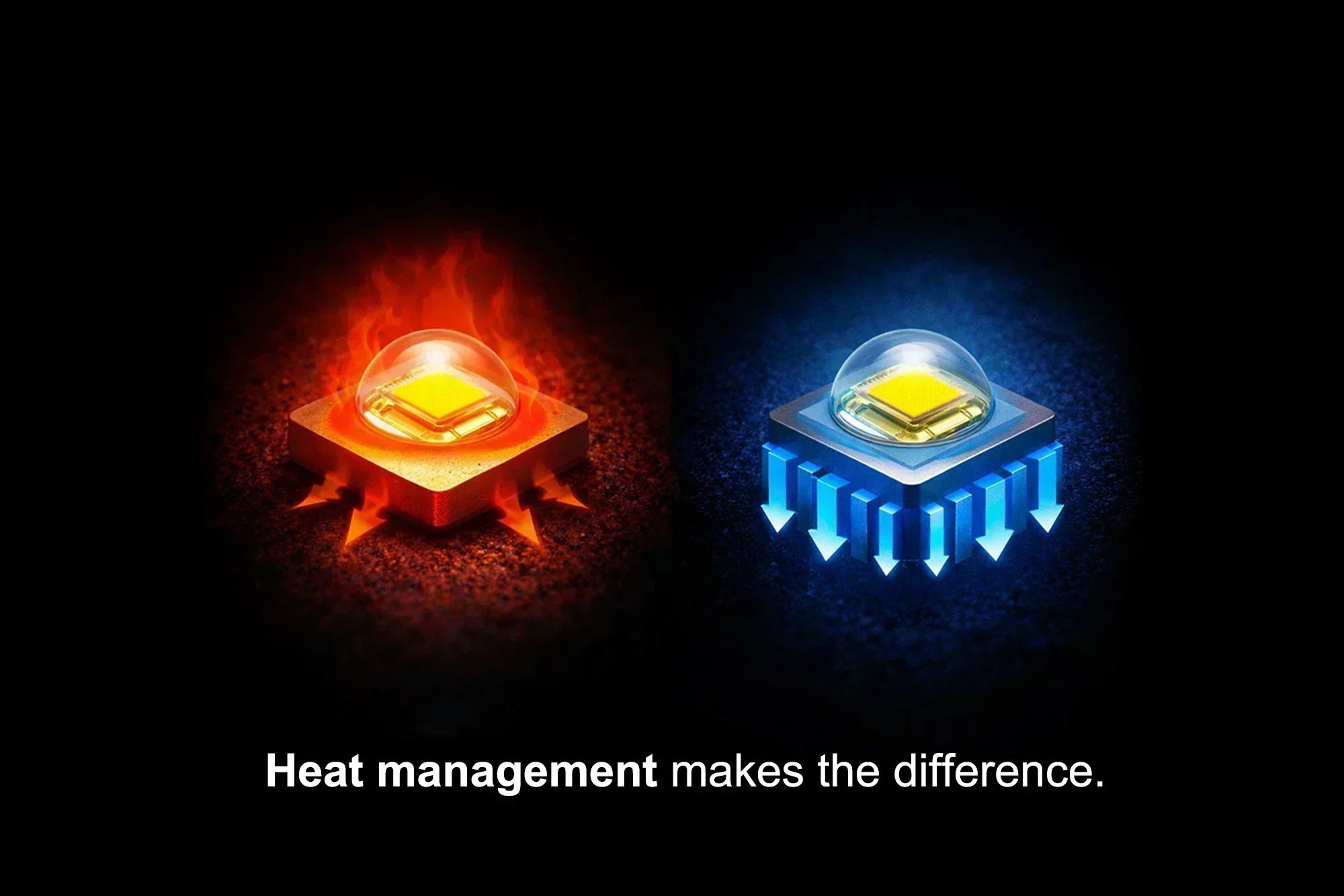
Why Does Your Flashlight Get Hot?
If a high-output flashlight becomes warm on Turbo or High mode, that does not automatically mean something is wrong.
LEDs and electronics use electrical power, and not all of that energy becomes visible light. Some becomes heat.
The important question is not simply “Does it get hot?”
It is how the flashlight manages that heat during use.

High Output. Managed Heat.
The FIELDLUME TAC30 Tactical Flashlight delivers up to 2400 lumens and uses automatic output reduction during high-output operation.

Where Does the Heat Come From?
An LED converts electrical energy into light, but the process is not perfectly efficient.
Some energy becomes heat inside the LED and electronics.
At higher output levels, the flashlight uses more electrical power, so more heat can be generated.
That heat moves through parts such as the LED board, flashlight head and metal body before being released into the surrounding air.
This is why the outside of a metal flashlight can become noticeably warm.
Does a Hot Flashlight Mean It Is More Powerful?
No.
Surface temperature alone is not a reliable measure of flashlight performance.
How warm a flashlight feels depends on several factors:
- output level;
- flashlight size;
- material;
- thermal design;
- ambient temperature;
- airflow.
A compact light may feel warmer simply because the same amount of heat is concentrated into a smaller body.
Why Does Brightness Sometimes Drop?
Many high-output flashlights reduce output after operating on Turbo.
This is commonly called thermal step-down.
Reducing power lowers heat generation and can help the flashlight operate within its intended thermal range.
That does not automatically mean the battery is empty or the flashlight is faulty.
Related Guide: Why Do High-Lumen Flashlights Step Down? →
Why Does Ambient Temperature Matter?
A flashlight releases heat into the surrounding environment.
In cooler air, heat can generally move away from the body more easily.
In hot conditions, the temperature difference between the flashlight and the surrounding air is smaller, so cooling may be slower.
That means the same flashlight can behave differently depending on weather, airflow and how it is being held or used.

A Real-World Example: FIELDLUME TAC30
The FIELDLUME TAC30 provides up to 2400 lumens in Turbo mode with lower output levels available for longer use.
Its automatic output reduction during high-output operation is a practical example of how brightness and thermal management can work together.
The key point is simple:
Peak output and sustained output are different parts of flashlight performance.
Key Takeaway
It is normal for many high-output flashlights to become warm during use.
What matters is the complete system:
Output + Thermal Design + Step-Down + Battery + Ambient Conditions
Heat alone does not prove quality, and a flashlight should not be judged only by how hot it becomes or by its maximum lumen number.
See High-Output Thermal Management in Real Use
The FIELDLUME TAC30 Tactical Flashlight combines a 2400-lumen Turbo mode with multiple lower output levels for different lighting needs.

FAQ
Is it normal for an LED flashlight to get warm?
Yes. High-output LEDs and electronics generate heat during operation.
Does a hot flashlight mean it is more powerful?
No. Surface temperature depends on many factors and is not a reliable performance measure.
Why does my flashlight dim after a few minutes?
Many high-output flashlights use thermal step-down or other output-management logic after running at high power.
Share:
IP65 vs IP68: What Do Flashlight Water-Resistance Ratings Mean?
Red vs Green Light: Which Beam Color Is Better for Night Use?