


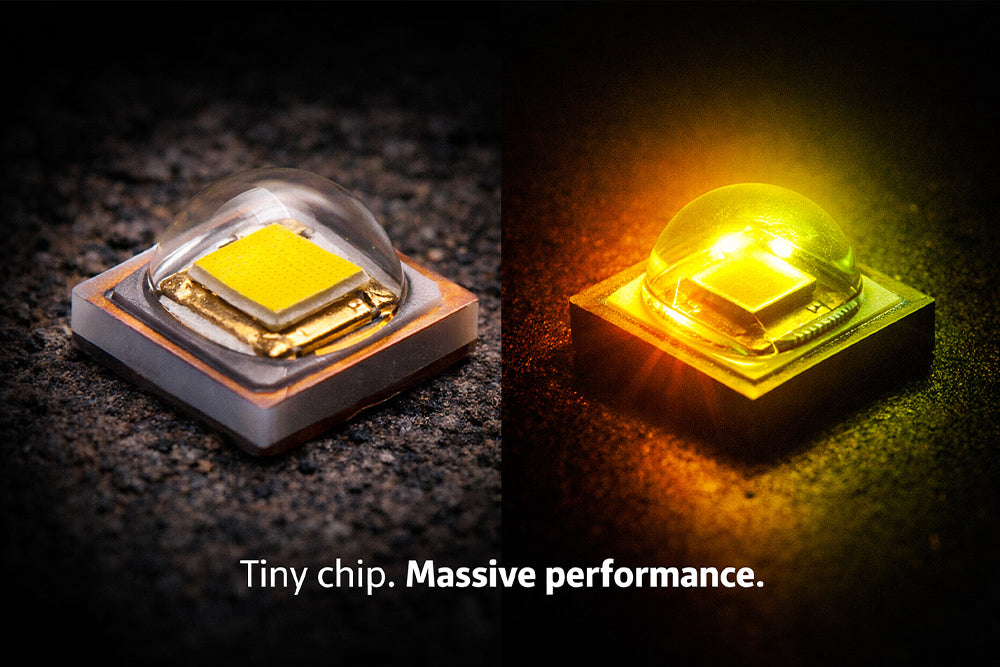
How Do Flashlight LEDs Work?
Modern flashlights can produce a surprising amount of light from a very small LED.
Unlike older incandescent bulbs, an LED does not use a glowing filament. Instead, it produces light through a semiconductor.
So how does that tiny component become a usable flashlight beam?
Multiple LEDs. Multiple Lighting Functions.
The FIELDLUME T2 Titanium EDC Torch combines white, red and UV LEDs in one compact design for everyday lighting and inspection tasks.

What Is an LED?
LED stands for Light-Emitting Diode.
An LED is a semiconductor device. When electrical current passes through it, electrons and other charge carriers interact inside the semiconductor material and release energy as light.
That light is produced without the fragile filament used in traditional incandescent bulbs.
This is one reason LEDs have become the standard light source in modern flashlights.

Why Can LEDs Produce Different Colors?
Not every LED produces the same light.
The materials and design of the semiconductor determine the wavelengths of light it emits.
That allows flashlights to use different LED types for different purposes, including:
- white light for general illumination;
- red light for low-light tasks;
- UV light for inspection applications.
A multi-function flashlight may therefore contain more than one LED rather than trying to create every lighting mode from a single emitter.
Why Do Flashlight LEDs Get Hot?
LEDs are efficient, but they do not convert all electrical energy into visible light.
Some energy becomes heat.
At higher output levels, more electrical power is being used, so heat management becomes increasingly important.
In a flashlight, heat can move from the LED into the circuit board, flashlight head and metal body before being released into the surrounding air.
This is why a high-output flashlight can become warm during use.
Learn more: Why Does Your Flashlight Get Hot? →
Link this to the existing Heat & Safety Guide.
Is the LED the Only Thing That Determines Performance?
No.
A good LED is only one part of a flashlight.
The final beam also depends on:
Optics — the reflector or lens determines how the light is distributed.
Electronics — the driver controls how electrical power is supplied to the LED.
Thermal design — heat management affects how the system behaves at higher output.
Battery — the power source must be able to support the required operating modes.
That means two flashlights using similar LEDs can still produce very different beams and user experiences.
A Real-World Example: FIELDLUME T2
The FIELDLUME T2 uses separate white, red and UV LED functions in a compact titanium EDC design.
It is a simple example of an important point:
LED selection depends on the task the flashlight is designed to perform.
The LED is the light source, but the complete flashlight determines how that light is controlled and used.
Key Takeaway
A flashlight LED is a semiconductor that converts electrical energy into light.
But flashlight performance is not determined by the LED alone.
A more complete way to think about the system is:
LED + Optics + Driver + Battery + Thermal Design
All of these parts work together to create the final beam.
See Multiple LED Functions in One Compact EDC
The FIELDLUME T2 Titanium EDC Torch combines white, red and UV LEDs for everyday carry, low-light use and practical inspection.

FAQ
Are LEDs the same as traditional flashlight bulbs?
No. LEDs are semiconductor devices and do not use a glowing filament.
Why do LED flashlights get warm?
Not all electrical energy becomes visible light. Some becomes heat, particularly at higher output levels.
Does a better LED always mean a better flashlight?
No. Optics, electronics, battery performance and thermal design also affect how the flashlight performs.
Share:
What Is Type III Hard Anodizing? Why Flashlights Use It
Why Do Some Flashlights Stay Bright While Others Gradually Dim?