


Flashlight Color Temperature Guide: Cool White vs Neutral vs Warm White
Two flashlights can produce a similar amount of light yet look noticeably different. One may appear crisp and bluish, another more balanced, and another warmer and softer.
That difference is largely described by correlated color temperature, or CCT. Understanding CCT can help you choose a flashlight that better suits the way you use it—but Kelvin is only one part of real-world flashlight performance.
Two Color Temperatures. One Compact EDC.
T4 combines a 6500K cool white main beam with a 4000K high-CRI warm white side light.

What Is Flashlight Color Temperature?
Color temperature describes the appearance of white light and is measured in Kelvin (K).
Lower Kelvin values generally appear warmer and more yellow, while higher Kelvin values appear cooler and more blue-white. CCT describes the appearance of the light itself; it does not tell you how bright the flashlight is. ENERGY STAR and the U.S. Department of Energy also distinguish CCT from color rendering, which is measured separately using metrics such as CRI.
For flashlights, the ranges below are useful as a general guide:
| Light Appearance | Approximate CCT | Typical Look |
|---|---|---|
| Warm White | 2700K–4000K | Warm, yellowish white |
| Neutral White | 4000K–5000K | Balanced, natural-looking white |
| Cool White | 5000K–6500K+ | Crisp, blue-white |
These ranges are approximate. Manufacturers may describe similar CCT values differently.

Cool White: Crisp and Clear-Looking
Cool white is common in modern flashlights and usually sits around 5000K to 6500K or higher.
It produces a crisp, cooler-looking beam that many users associate with high-output outdoor and utility lighting.
Cool white can work well for general illumination, equipment inspection, outdoor use and longer-range lighting when paired with suitable optics.
But an important distinction is:
Higher color temperature does not automatically mean more lumens or greater beam distance.
A flashlight's real performance depends on much more than CCT, including LED output, candela, reflector or lens design, beam shape and electrical regulation.
Neutral White: A Balanced Middle Ground
Neutral white generally falls around 4000K to 5000K.
It tends to look less blue than cool white and less yellow than warm white, which can make it comfortable for general-purpose use.
Neutral white is often useful for walking, outdoor tasks, inspection and situations where a balanced-looking beam is preferred.
However, neutral white should not automatically be described as having accurate color rendering.
CCT and CRI are different measurements.
CCT describes whether white light appears warmer or cooler. CRI describes how faithfully objects appear under that light compared with a reference source. A light can have a neutral CCT without having particularly high color fidelity.
If identifying subtle colors matters, check CRI as well as CCT.
Warm White: A Softer Lighting Character
Warm white generally falls around 2700K to 4000K.
It produces a warmer, more yellow-toned appearance and may feel softer during close-range use.
Some users prefer warmer light for camping, close work, general area lighting and other situations where a less blue-looking beam is desirable.
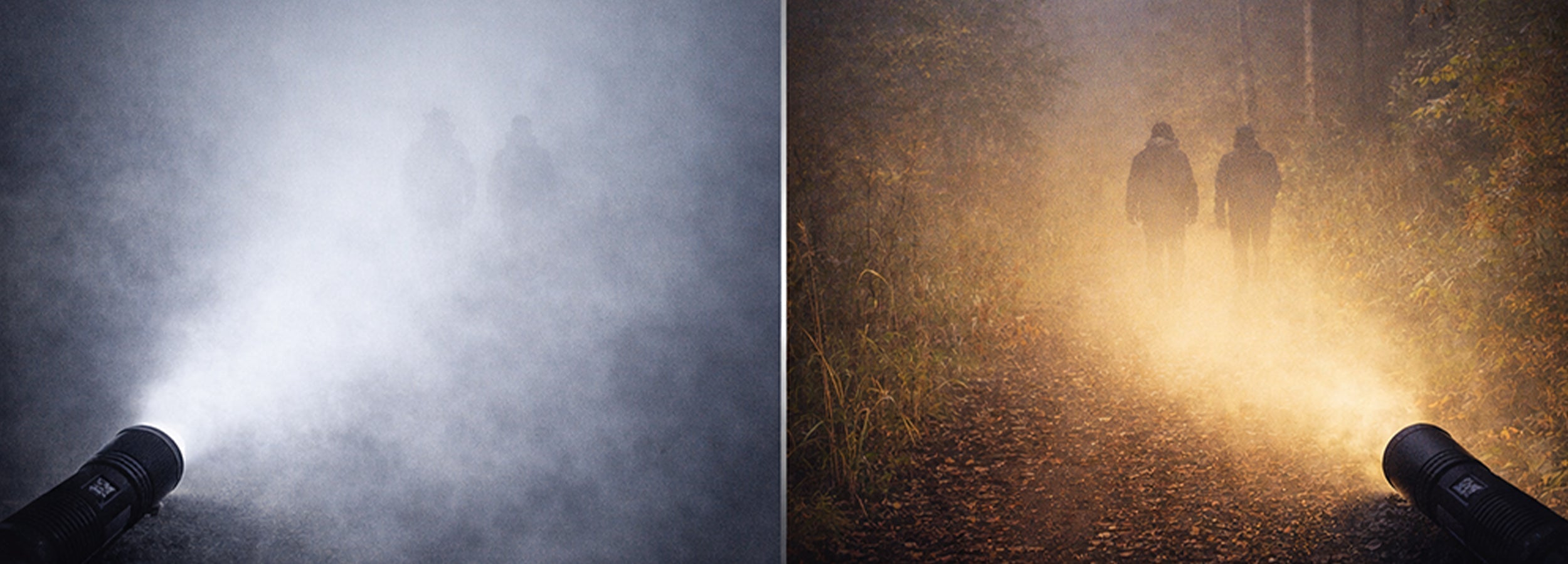
Warm light is also frequently discussed in relation to fog, rain and dust.
This is where flashlight advice often becomes too simple.
Does Warm White Really Work Better in Fog?
A common claim is:
Warm light cuts through fog better than cool light.
There is some scientific support for lower-CCT lighting performing better under certain dense-fog conditions, but it is not a universal rule.
A real-scale study involving 91 participants found that lower-color-temperature road lighting produced longer visibility distances in relatively dense fog, while higher-CCT lighting performed better as visibility conditions improved.
The important lesson is not that one color temperature always wins.
It is that visibility depends on the specific conditions and the complete lighting system.
For a flashlight, factors such as beam intensity, beam width, reflector or lens design, fog density, target contrast, distance and viewing angle can all affect what the user actually sees.
So the safer conclusion is:
Color temperature can influence visibility, but CCT alone does not determine poor-weather performance.
Color Temperature Is Only One Part of Beam Performance
Two flashlights with the same CCT can behave very differently.
One may produce a wide flood beam for close-range use, while another concentrates its output into a tighter hotspot for longer-distance visibility.
When comparing flashlights, also consider lumens, candela, beam pattern, optics, CRI, runtime and output regulation.
For example, lumens describe total light output, while candela tells you more about how strongly that light is concentrated in a particular direction.
Learn the difference between lumens and candela →
Link this to your finalized Lumens vs Candela Guide.
Another major factor is reflector design.
See how reflector design changes flashlight beam shape →
Link this to your finalized SMO vs OP Reflector Guide.
Cool White vs Neutral White vs Warm White
| If You Prefer... | Consider... | Keep in Mind |
|---|---|---|
| A crisp, cooler-looking beam | Cool White | CCT alone does not determine brightness or range |
| A balanced white appearance | Neutral White | Check CRI separately when color accuracy matters |
| A softer, warmer-looking beam | Warm White | It is not automatically superior in all weather conditions |
| Better color recognition | Higher CRI | CRI and CCT describe different characteristics |
| Greater beam distance | Candela and optics | Kelvin cannot predict throw by itself |
| Fog, rain or dust performance | The complete beam system | Conditions and beam design matter |
Which Flashlight Color Temperature Should You Choose?
There is no single color temperature that is best for every user or every situation.
Choose based on how you intend to use the light.
If you prefer a crisp, modern-looking beam, cool white may suit you.
If you want a balanced general-purpose appearance, neutral white may be a better fit.
If you prefer a warmer-looking beam for close-range lighting, warm white may be more comfortable.
If accurate color recognition matters, look at CRI in addition to CCT.
For longer-range lighting, give more attention to candela, optics and beam pattern.
For fog, rain or dust, consider the entire lighting system rather than choosing a flashlight based on Kelvin alone.
A Real-World Example: Two CCTs in One Flashlight
Some multi-function flashlights use different light sources because different tasks benefit from different lighting characteristics.
The FIELDLUME T4 is a good example.
Its main LED produces a 6500K cool white beam, while its side lighting includes a 4000K high-CRI 90 warm white light for close-range tasks.
That does not mean one color temperature is better than the other.
Key Takeaway
Flashlight color temperature changes how white light looks, but it does not tell you everything about how a flashlight will perform.
A better way to evaluate a flashlight is to consider:
CCT + CRI + Lumens + Candela + Optics + Beam Pattern + Intended Use
That gives you a much more complete picture than choosing by Kelvin alone.
See Color Temperature in Real Use
The FIELDLUME T4 Titanium EDC Torch combines a 6500K cool white main beam with a 4000K high-CRI warm white side light, plus additional side-light functions in one compact titanium EDC design.

Share:
SMO vs OP Reflector: What’s the Difference in a Flashlight Beam?
How CNC-Machined Aluminum Flashlight Bodies Are Made