


Candela Explained: What Does It Mean for a Flashlight?
Lumens tell you how much visible light a flashlight produces.
Candela tells you how strongly that light is concentrated in a particular direction.
This makes candela especially useful when comparing flashlights designed for longer-distance visibility.
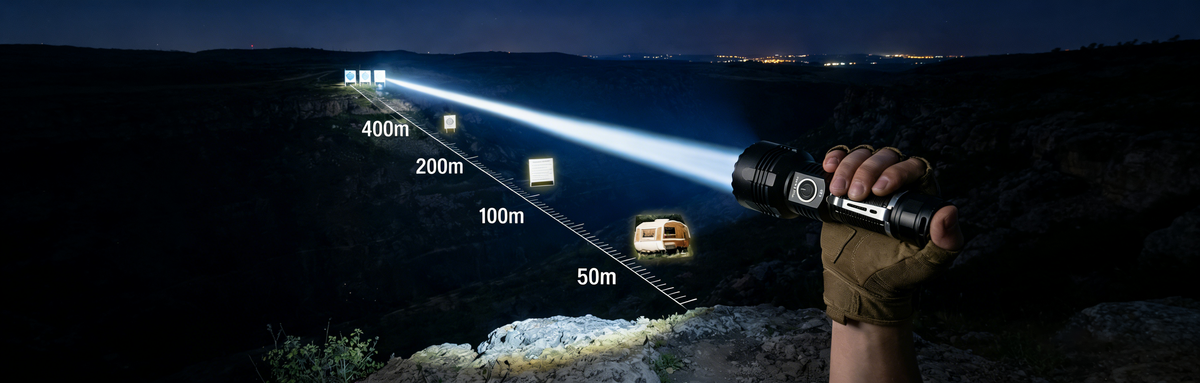
Focused Light. Longer-Range Visibility.
The FIELDLUME TAC30 Tactical Flashlight combines up to 2400 lumens with a focused beam reaching up to 590 meters.

What Is Candela?
Candela, abbreviated cd, is the SI unit of luminous intensity.
In simple terms, it tells you how intense the light is in a particular direction.
That is different from lumens.
Lumens = total visible light output
Candela = directional light intensity
A flashlight can therefore produce a lot of lumens but relatively low candela if the beam is spread across a wide area.
Another flashlight can concentrate its light into a tighter beam and produce much higher candela.

Why Does Candela Matter for Beam Distance?
Long-range flashlights need to concentrate enough light toward the target.
A wider flood beam spreads light over a larger area.
A tighter beam concentrates more of that light toward the center.
That is why higher candela is generally associated with stronger beam intensity and greater potential beam distance.
But candela is not the only factor. The reflector, lens, LED position and overall optical design all affect the final beam.

Lumens vs Candela
A simple way to remember the difference is:
Lumens tell you how much light you have.
Candela tells you how concentrated that light is.
For close-range flood lighting, high total output may be more important.
For long-range visibility, candela becomes particularly useful.
Related Guide: Flashlight Lumens Explained →
Link this to the article we just completed.
High Candela Does Not Mean “Better”
A high-candela flashlight is not automatically better than a lower-candela one.
It depends on the job.
A focused beam is useful for:
- longer-distance visibility;
- open outdoor areas;
- identifying objects farther away.

A wider beam may be more useful for:
- walking;
- close-range work;
- campsites;
- general area lighting.
The best beam is the one that suits the intended use.
A Real-World Example: FIELDLUME TAC30
The FIELDLUME TAC30 is specified at up to 2400 lumens with a beam distance of up to 590 meters.
Those two specifications describe different parts of its performance.
The lumen figure describes total light output.
The beam-distance figure reflects how the complete optical system projects that light forward.
This is why looking only at lumens gives an incomplete picture.
Key Takeaway
Candela measures directional light intensity.
When comparing flashlights:
Lumens = total output
Candela = beam intensity
Optics = how the light is shaped
All three help explain what the beam will actually do.
See Focused Beam Performance in Real Use
The FIELDLUME TAC30 Tactical Flashlight combines high output with a focused long-range beam for outdoor and tactical use.

FAQ
Does higher candela mean longer beam distance?
Generally, higher candela means stronger directional intensity, which supports longer-distance beam performance.
Is candela more important than lumens?
It depends on the use. Candela matters more when beam intensity and distance are important, while lumens describe total light output.
Can two flashlights have the same lumens but different candela?
Yes. Different optics can spread or concentrate the same amount of light very differently.
Share:
Flashlight Lumens Explained: Does More Mean Better?
Lumens vs Candela: Which Matters More in a Flashlight?