


BLOOD TRACKING SERIES 03
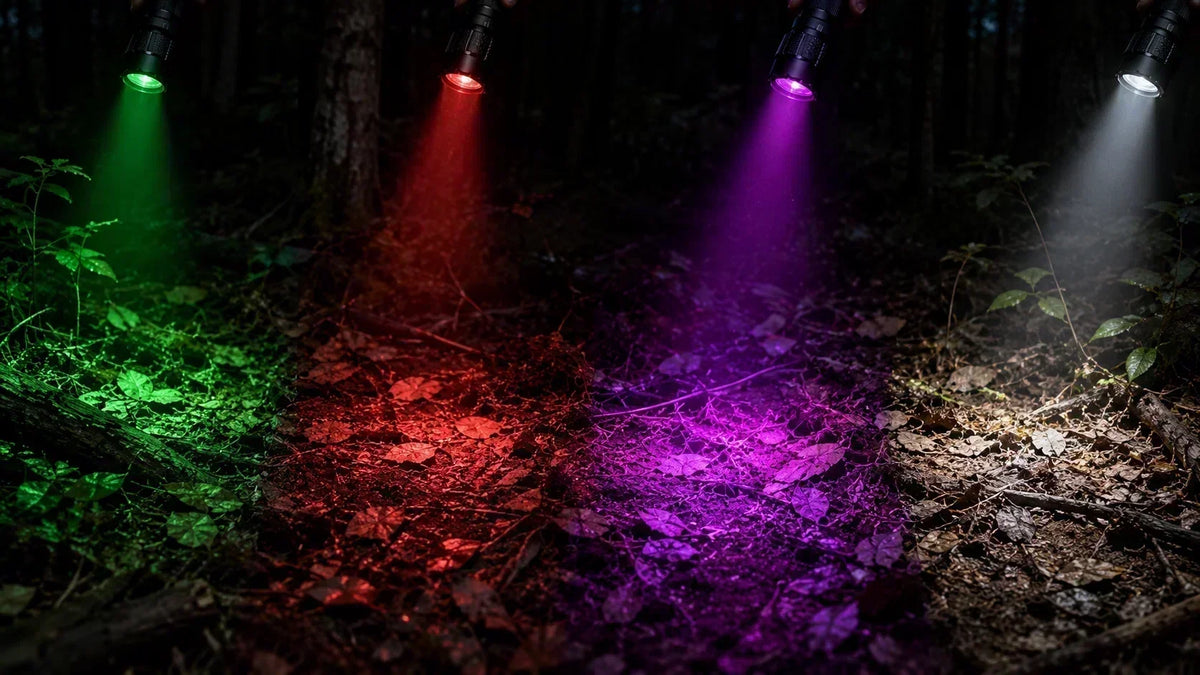
Green, red, UV or white? The most useful tracking light depends on more than color alone.
Quick Answer
There is no single light color that performs best for blood tracking in every environment.
Green, red, ultraviolet and white light interact differently with surfaces, vegetation and trail indicators. A light that creates useful contrast on one background may be less effective on another.
For low-light tracking, the better question is not simply “Which color is best?” but which optical system creates the most useful contrast under the conditions you are searching in.

Why Does Light Color Matter?
Different materials absorb and reflect different parts of the light spectrum.
Changing the light source can therefore change the relative brightness and color of leaves, soil, bark and other surfaces. This can make a subtle visual clue more noticeable—or make it blend further into the background.
Research using forensic alternate light sources shows the same broad principle: wavelength can affect visibility, but the substrate underneath the material has a major influence on the result. Alternate light is therefore useful as a visual aid, not as a universal detector.
For a deeper explanation, see BT-02 — How Does a Blood Tracking Light Work?
Green Light
Green light can create strong visual differences in vegetation and other naturally colored surfaces, which is why green wavelengths often appear in discussions about tracking and alternate-light examination.
However, that does not mean green light will always produce the best result.
Leaf color, moisture, soil and the optical design of the flashlight can all change what the user sees.
The practical advantage of green light is therefore potential contrast, not guaranteed detection.

Red Light
Red illumination changes the scene in a very different way.
Certain colors may become darker or less visually dominant, while other surfaces remain easier to distinguish. This can be useful in some environments, but red light should not be treated as a universal blood-tracking solution either.
Its effectiveness still depends on the background, beam intensity and the visual clue being examined.

UV Light
UV is probably the most misunderstood option.
Blood does not simply glow brightly whenever ultraviolet light is used.
Research has shown that blood serum and plasma can fluoresce under specific UV conditions:
Ultraviolet 365 as an Alternative Light Source for Detection of Blood Serum
Including 365 nm, but that is not the same as saying ordinary whole-blood trails universally fluoresce under a UV flashlight.
For hunters, UV should therefore be viewed as a specialized optical tool—not a magic blood detector.

White Light
White light remains extremely useful.
It provides natural general illumination, helps with navigation and allows the user to examine the broader environment without relying on a specialized tracking mode.
A good white flashlight may perform very well in some tracking situations.
However, strong white illumination can also create reflections or glare from wet leaves and pale surfaces, making subtle differences harder to notice in certain conditions.
That is why brightness alone does not determine tracking performance.
So Which Color Is Best?
The most accurate answer is:
It depends on the surface, environment and optical system.
| Light | Best understood as | Main limitation |
|---|---|---|
| Green | A contrast option for selected environments | Results vary with background |
| Red | An alternative visual contrast option | Not universally better |
| UV | A specialized optical tool | Whole blood does not reliably “glow” |
| White | General illumination and searching | Bright reflections may reduce useful contrast |
A purpose-built tracking light may use selected light or optical filtering rather than relying on one simple color alone.

FIELDLUME B1 Blood Tracking Light
The FIELDLUME B1 Blood Tracking Light 1800LM uses optical filter technology to provide a purpose-built visual tool for low-light tracking.
Rather than claiming one color is always best, the design focuses on creating useful contrast in real outdoor conditions.
VIEW THE B1 BLOOD TRACKING LIGHT →

Share: