


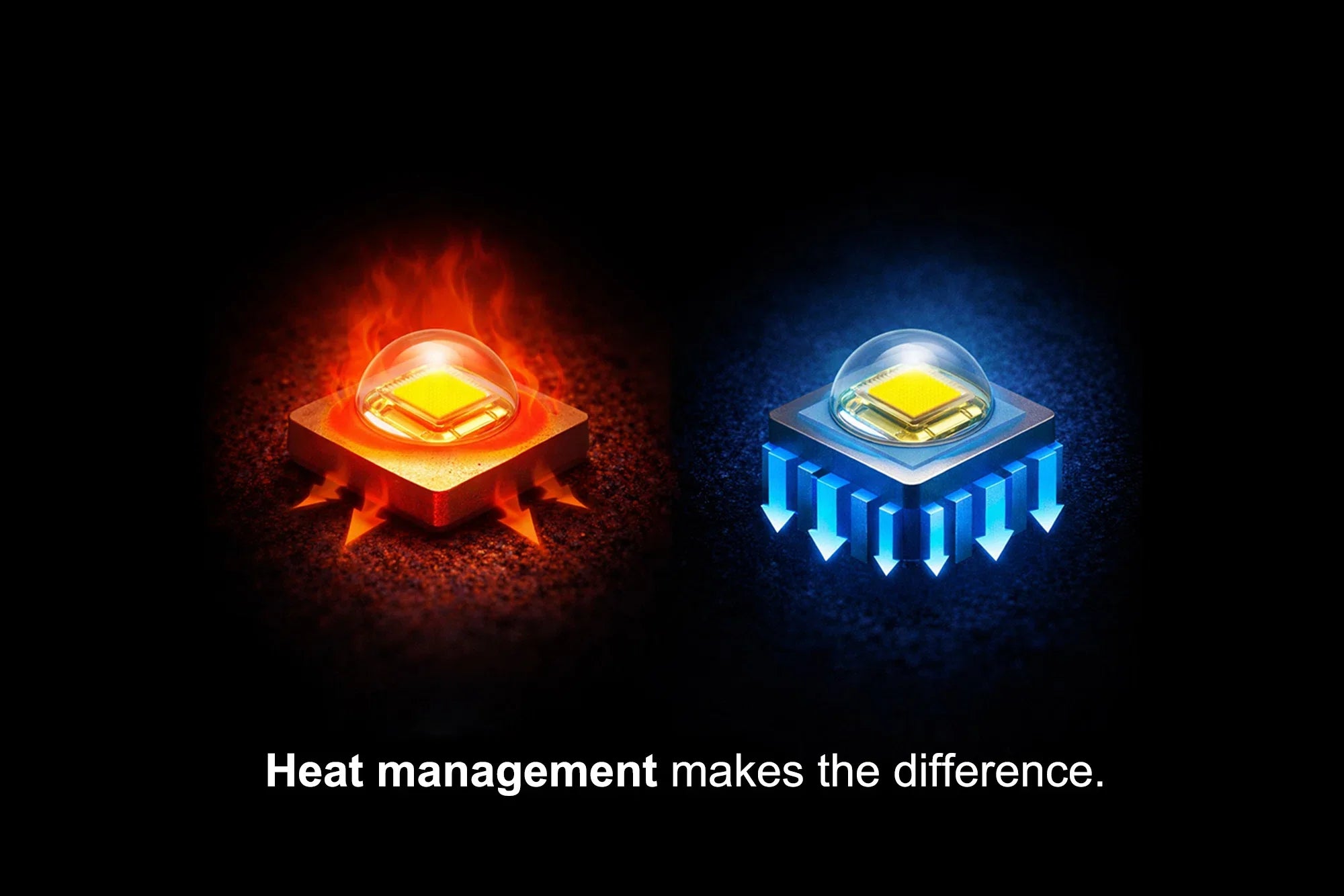
Your flashlight gets hot.
👉 Is that normal… or dangerous?
If you've ever felt your flashlight heating up in your hand,
you're not alone.
Many people worry:
- Is it overheating?
- Is it unsafe?
- Did I buy a bad product?
👉 The truth is:
Heat is not the problem.
👉 Uncontrolled heat is.

⚡ The Short Answer
👉 Yes — heat is completely normal.
In fact:
👉 Heat is a direct result of high performance.
💡 Where Does the Heat Come From?
A modern LED flashlight is extremely powerful.
But here's the truth most people don't realize:
👉 Not all energy becomes light.
A significant portion becomes heat.
Think of it like this:
- More brightness = more power
- More power = more heat
👉 That's why:
A 2000+ lumen flashlight will always generate noticeable heat.

👉Buy now: FieldLume L26 4000 lumens High Power Torch
🌡️ When Is Heat a Good Sign?
A flashlight that gets warm (or even hot) on high mode usually means:
✔ It's producing real output
✔ It's driving the LED properly
✔ It's not artificially limited
👉 In other words:
If your flashlight never gets warm,
👉 it's probably not as powerful as advertised.

Here's something most brands won't tell you:
👉 Cheap flashlights often look bright at first…
But they achieve this by pushing unsafe power levels
without proper heat control.
That's why:
- They overheat quickly
- They dim suddenly
- Or worse — they fail when you need them most
⚠️ When Heat Becomes a Problem
Heat is normal — but uncontrolled heat is not.
🚨 Warning signs:
- Gets extremely hot within seconds
- Becomes uncomfortable to hold
- Brightness drops suddenly
- Turns off unexpectedly
👉 These usually indicate:
- Poor heat dissipation
- Cheap internal design
- Unstable driver circuit
🧠 How High-Quality Flashlights Handle Heat
Professional-grade flashlights are designed to manage heat safely:
✔ Thermal regulation (Step-down)
Automatically reduces brightness
to prevent overheating
✔ Efficient heat dissipation
- Aluminum body
- Cooling fins
- Internal thermal path
✔ Stable driver system
Maintains consistent output
without dangerous spikes
👉 This is what separates real tools from cheap gadgets.
🏾d FieldLume's Approach
At FieldLume, heat is not ignored —
it's engineered.
✔ CNC-machined aluminum body
✔ Optimized thermal structure
✔ Intelligent step-down system
👉 So you get:
- Maximum performance
- Without sacrificing safety
Overheating is not a feature.
👉 It's a design failure.

Anyone can build a bright flashlight.
👉 Not everyone can build a stable one.
📊 Quick Summary
- Heat = normal for powerful flashlights
- Too much heat = design problem
- Good flashlights manage heat automatically
It's completely normal for a flashlight to get hot on high mode.
Brightness means nothing without stability.
🚀 Final Thought
A flashlight that produces no heat
is not impressive.
👉 A flashlight that controls heat is.

🔦 Don't Trust Brightness Alone — Trust Stability
Don't trust a flashlight just because it's bright.
👉 Trust one that stays stable under pressure.
https://fieldlume.com.au/products/fieldlume-tac30-red-tactical-torch-3000lm

Share:
11- What Does IP68 Really Mean? (And Can You Trust It?)
13- Why Do Hunters Use Red or Green Light?